One Click, $1.84 Million Gone: How a Single Email Almost Killed Apex Marketing (and How They Fought Back)
On a warm Tuesday in September, the finance team received an email that looked exactly like the ones they saw every quarter....

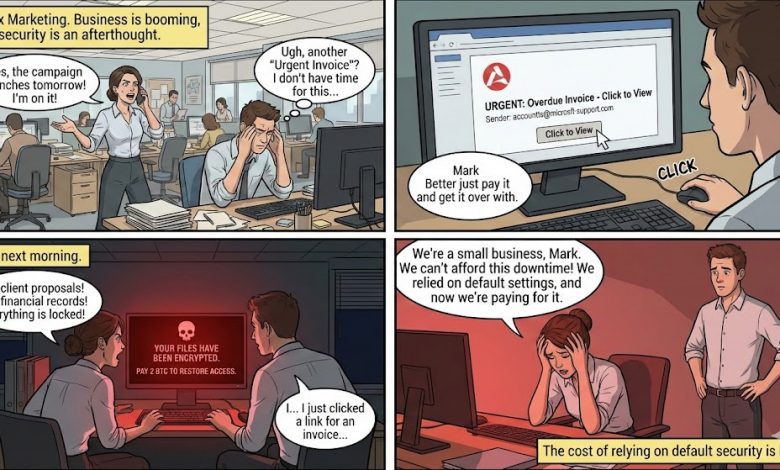
 Apex Marketing was the kind of agency that won awards for creativity and lost them for discipline.
With 180 employees spread across three floors of a glass-walled building in downtown Austin, they lived on Microsoft 365: Teams chatter never stopped, OneDrive was stuffed with pitch decks, and Outlook inboxes overflowed with client threads that often began “Quick favor…”
On a warm Tuesday in September, the finance team received an email that looked exactly like the ones they saw every quarter.
Subject: Urgent: Direct Deposit Update Required
The body of the email read:
Microsoft 365 has detected an issue with your banking details. Click below to verify before end-of-day or your paycheck will be delayed.
The sender address was perfect. The company logo was perfect. The urgent tone was perfect.
Sarah, the accounts-payable specialist, clicked at 2:17 p.m. Thirty-seven seconds later, a credential-harvesting page captured her Microsoft 365 username and password. By 2:29 p.m. the attacker was in.
By 3:05 p.m. they had tenant Global Admin privileges—Sarah had once been granted permanent admin rights “just in case the CFO was traveling.”
By 4:12 p.m. they were exfiltrating every client contract in the company OneDrive.
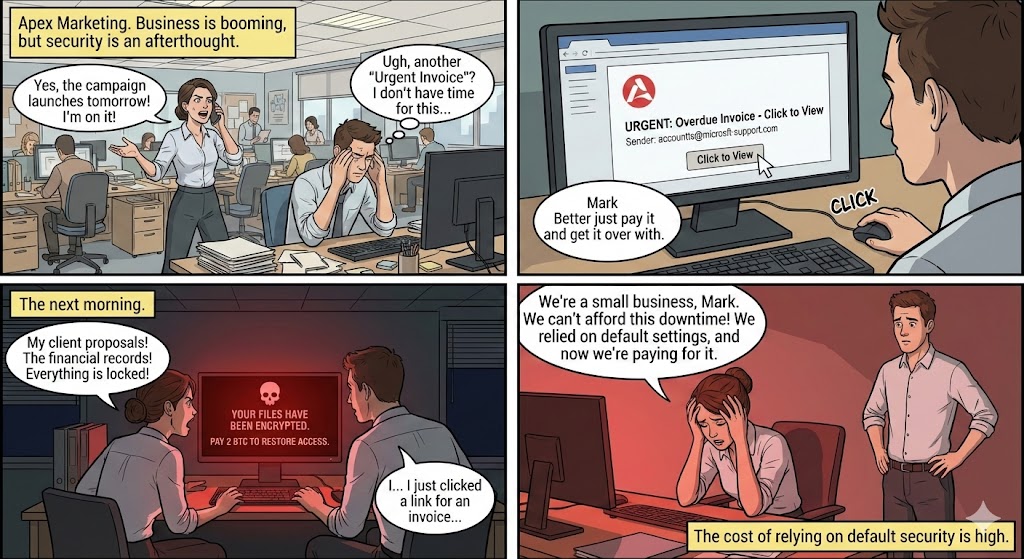
By 6:03 p.m. a $1.84 million invoice was submitted to a long-standing client, paid within the hour to a new bank account in Eastern Europe.
The ransom note arrived Wednesday morning: $4 million in Bitcoin or the stolen contracts go public and every employee’s personal data hits the dark web.Apex paid $2.9 million from their insurance policy and still lost three major clients. The stock of their parent holding company dropped 14 % in a single day.
Calling in the Experts
The morning after the ransom note, Apex Marketing’s boardroom was chaos. CEO Mark Harlan paced while Sarah stared at her phone in shock. By 10 a.m., Microsoft security consultants arrived – Lead expert Elena Vasquez took charge:
“We’re containing the situation.”
Her team revoked Sarah’s admin rights, enforced least-privilege access, and isolated compromised devices with Defender for Endpoint. They traced the breach to one phishing email, locked down OneDrive with sensitivity labels, disabled external sharing, and activated Advanced Threat Protection.
MFA was forced via Conditional Access, legacy authentication killed, and Sentinel alerts scripted for suspicious logins. In 48 hours, the Secure Score jumped from 32 to 68.

Elena left a three-month hardening roadmap and a blunt warning: “Your setup was built for speed, not security. That changes now.”As her team drove off into the rain, Apex finally had breathing room—but the real work was just beginning.
The Final Phase
Month 3 – The New Normal. The first simulated phishing test after the overhaul had a 41 % click rate. The second had 9 %.
The third had 0.7 %—and the one person who clicked was the CEO, who laughed, took the retraining, and sent a company-wide email: “If I can get caught, anyone can. Stay sharp.”Apex Marketing never paid another ransom.

Clients quietly returned once they saw the new compliance reports stamped with “Microsoft 365 Secure Score: 94/100.”The glass-walled office still buzzed with creativity, but now every laptop had a small silver Yubikey dangling from the USB port, and the phrase “Have you MFA’d?” became as common as “How’s your weekend?”One click had cost them millions.
A hundred small controls made sure it would never happen again.
[box type=”success” align=”” class=”” width=””]
 Secure Your Business >>
Avoiding this same scenario is easy, with the right expert support.
Our 365 Security Experts can help audit, configure and monitor your environment to ensure you’re fully protected at all times.
[/box]